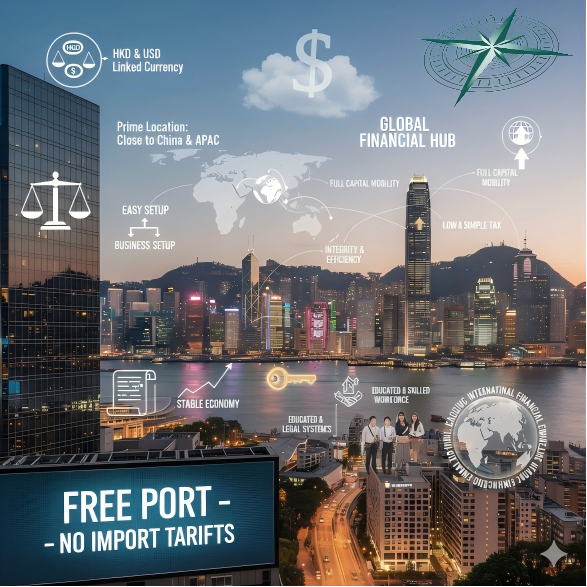




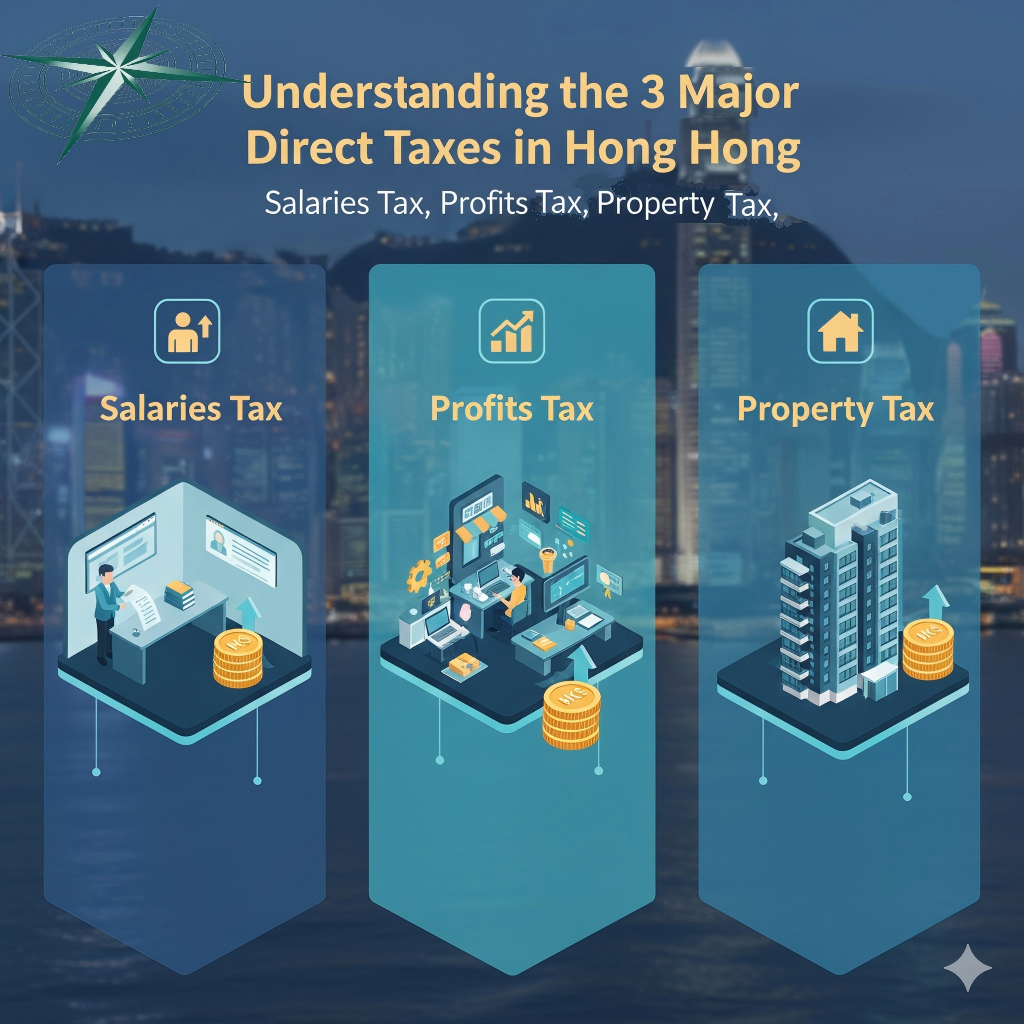
Hong Kong’s tax rates have long been renowned for being lower and simpler than those in most other countries. This system has helped the region become an international financial hub, attracting businesses and professionals worldwide to work and conduct business. In this article, we will explore Hong Kong’s tax rates, focusing on three main categories: salaries tax, profits tax, and property tax.
Introduction to Salaries Tax
Under Hong Kong tax regulations, the following categories are subject to salaries tax:
- Hong Kong residents: Individuals residing in Hong Kong are subject to salaries tax based on their income earned within the territory. Eligibility for resident status is generally determined by the duration and purpose of their stay in Hong Kong.
- Non-residents of Hong Kong: Non-residents may also be required to pay salaries tax, depending on their employment and income status in Hong Kong. For instance, foreign nationals working in Hong Kong with income derived from local companies or institutions are subject to salaries tax.
- Public servants: All individuals holding public office in the Hong Kong government, regardless of their residency status, are required to pay salaries tax on their public service income.
- Retirement income recipients: If you retire in Hong Kong and receive pension income, you may be required to pay salaries tax. Pension income typically includes payments from pension schemes, provident fund schemes, or other retirement arrangements.
It should be noted that Hong Kong’s salaries tax is levied on income earned within the territory, rather than on global income.
When calculating salaries tax, individuals can claim various deductions and tax exemptions, such as the child tax allowance, the dependent parent tax allowance, and charitable donations deductions. These deductions and allowances help reduce the individual’s net taxable income, thereby lowering the amount of salaries tax payable.
Payroll tax rate
The salary tax amount is calculated based on either your actual taxable income for the tax year at a progressive rate, or your net income at a standard rate, whichever is lower.
progressive tax rate
| tax year | 2018/19 and onwards | ||
| net taxable income | tax rate | tax | |
| Original | 50,000 | 2% | 1,000 |
| Secondly | 50,000 | 6% | 3,000 |
| 100,000 | 4,000 | ||
| Secondly | 50,000 | 10% | 5,000 |
| 150,000 | 9,000 | ||
| Secondly | 50,000 | 14% | 7,000 |
| 200,000 | 16,000 | ||
| Balance | 17% | ||
standard tax rate
| standard tax rate | 15% |
Brief Introduction to Profit Tax
Hong Kong’s profit tax is a taxation system levied on profits generated from business transactions conducted within Hong Kong. Renowned for its simplicity, transparency, and low tax rates, Hong Kong’s profit tax system provides a competitive business environment, attracting numerous international companies and investors.
The scope of Hong Kong’s capital gains tax includes:
- Profits of enterprises, companies, and sole proprietorships operating in Hong Kong.
- The profits of the partnership operating in Hong Kong.
- Revenue from other profit-making operations in Hong Kong, such as professional services and advisory services.
Notably, Hong Kong’s capital gains tax is levied based on the territorial origin principle, taxing only profits generated within Hong Kong territory rather than global income. Moreover, Hong Kong does not impose capital gains tax, meaning capital gains from asset sales or stock transactions are generally exempt from taxation.
Profit tax rate
To enhance Hong Kong’s business environment, the Hong Kong government introduced a two-tier profit tax system in the 2018/19 tax year (effective April 1, 2018). This system applies to all entities in Hong Kong subject to profit tax, helping to reduce the overall tax burden on businesses, including corporations and unincorporated entities.
Under the two-tier profit tax system, limited companies will be subject to a reduced profit tax rate of 8.25% on the first two million yuan of taxable profits, with the rate remaining at 16.5% for any amount exceeding this threshold. For unlimited companies (i.e., sole proprietorships or partnerships), the profit tax rate will be lowered to 7.5% on the first two million yuan of taxable profits, while the rate will stay at 15% for any amount beyond this amount.
Introduction to Property Tax
The Property Tax in Hong Kong is levied on rental income from land and properties under Chapter 112 of the Hong Kong Laws, the Inland Revenue Ordinance. Its primary purpose is to generate revenue for the Hong Kong Special Administrative Region Government, which is used to support public services and infrastructure development.
The property tax in Hong Kong applies to the following categories:
- All land and property within Hong Kong, including residential, commercial, and industrial properties;
- rental income generated by rental properties;
- All property owners in Hong Kong, regardless of their residency status.
Notably, the property tax applies only to land and real estate within Hong Kong and excludes overseas properties. Moreover, owners of self-used or vacant properties are exempt from paying the tax.
Property tax rate
Hong Kong’s property tax rate is relatively low at 15% of income. Under the Tax Ordinance, owners are eligible for a 20% allowable deduction on rental income to cover maintenance and management costs when calculating the payable property tax.
In certain circumstances, property owners may apply to combine property tax revenue with personal income tax under the ‘personal income tax’ category for calculation purposes.