



With the growing number of startups in Hong Kong in recent years, many companies inevitably face challenges when filing their first tax return, including how to correctly claim tax benefits and deductions.
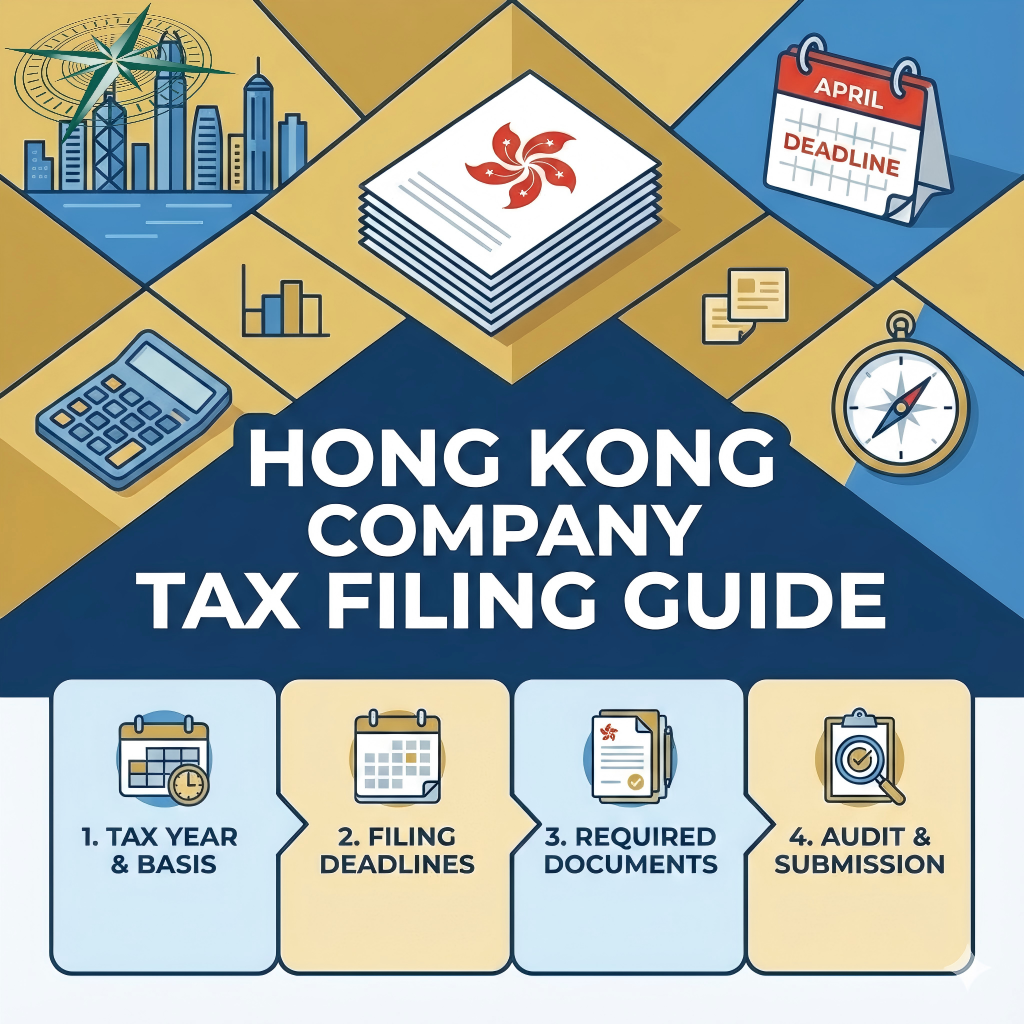
In April, small and medium-sized enterprises (SMEs) receive profit tax returns from the tax authorities. From July to August, the peak tax filing period arrives, and companies often handle various types of income and expenses in their operations, requiring extra caution when filing taxes.
Hong Kong profit tax scope
Hong Kong applies the “territorial origin principle” in taxation, meaning only profits originating from Hong Kong are subject to taxation in Hong Kong, while profits from other regions are exempt from profit tax in Hong Kong. This “territorial origin principle” ensures that Hong Kong residents and non-residents are treated equally in tax assessment within Hong Kong.
For example, if you do business in Hong Kong and your profits are derived from outside Hong Kong, you are not subject to income tax. Similarly, if non-residents earn profits from Hong Kong, they are also subject to income tax.
Who should declare taxes in Hong Kong?
1. Newly incorporated limited company
Limited companies are required to file their corporate income tax returns annually during the first tax year. The first return is typically received approximately 18 months after the company’s incorporation.
2. Operating company
The company’s profit tax return is received on the first working day of April each year. After receiving the return, the company must submit the tax return, audit report, calculation sheet of taxable profit (or adjusted loss), and necessary supplementary forms to the tax authority within one month.
3. Unoperating company
Not all companies are required to pay taxes, but you must file your tax return when you receive it.
If the Inland Revenue Department (IRD) determines that your company has not commenced operations or that your business has not generated taxable profits, you may not receive the annual ‘Gains Tax Return’.
4. Individuals who are sole proprietors, freelancers, or self-employed
Whether you are a partner in a partnership, a sole proprietor, or a freelancer earning income in Hong Kong, you are subject to tax obligations.
Tax year
Tax assessment is conducted based on the Assessment Year, with the assessment base period being: (1) the year ending on March 31 of the relevant Assessment Year; or (2) if the year-end is not on March 31, the fiscal year ending on March 31 of the relevant Assessment Year. Thus, the year ending March 31,2025 is designated as the 2024-2025 Assessment Year.
Profit tax rate
| taxable profit | corporation | non corporation |
| taxable profit before 2 million | 8.25% | 7.5% |
| Excess of assessed profit over HK$2,000,000 | 16.5% | 15% |
Tax filing deadline
As mentioned earlier, the tax authority sends out the Profit Tax Return Form to operating companies in early April each year. The deadline for submitting the Profit Tax Return Form varies depending on the accounting year.
Check-out date: Check-out date “N” category (check-out dates between April 1 and November 30)
Date of submission can be extended to: 2 May next year
Check-out date: Check-out date “D” category (check-out dates between December 1 and December 31)
Date of submission can be extended to: August 15 next year
Due Date: Due Date “M” category (due dates between January 1 and March 31)
Submission deadline extended to: 15 November of the same year
Closing Date: Cases in the “M” category that incurred losses during the current year
You can submit until: January 31 next year *
The extension request must be submitted by October 31
Other key date for tax filing
Event: Annual General Meeting (AGM)
Milestone: If the accounting reference period is the first such period for the company and exceeds 12 months, the company must hold its annual general meeting within the following timeframe:
- within 9 months after the first anniversary of the incorporation of the corporation as a corporation; or
- The annual general meeting shall be held within three months after the end of the accounting reference period, whichever is later.
The company shall convene its annual general meeting within nine months after the end of the accounting reference period for each fiscal year.
Event: Annual Return (AR)
Milestone: Due annually (within 42 days after the company’s initial establishment, except for the first year).
What forms does the company need to submit when filing taxes?
- For individuals outside the company: BIR52 form
- For the company: BIR51 sheet
- For non-residents of Hong Kong: BIR54 form
Additionally, effective April 1, 2019, the Inland Revenue introduced supplementary forms to the Profit Tax Return for reporting information on preferential schemes and tax benefits. These supplementary forms are part of the Profit Tax Return and must be submitted together with the Profit Tax Return.
What tax incentives are available for companies when filing taxes?
Offshore fund or company
Hong Kong does not offer any specific incentives for foreign investment, but offshore funds or companies may be exempt from profit tax depending on the circumstances.
CDTA regional tax credit
If a Hong Kong tax resident pays foreign tax on income derived from a region with which Hong Kong has a Comprehensive Double Taxation Agreement (CDTA), and such income is subject to taxation in Hong Kong, the foreign tax liability is deductible. Prior to filing a tax credit claim, the taxpayer must take all reasonable measures to minimize the foreign tax payable.
Can the company deduct tax when filing taxes under double taxation?
To reduce tax rates and provide additional tax relief, Hong Kong has signed comprehensive double taxation avoidance agreements (tax treaties) with various jurisdictions. Through these tax treaties with other countries, Hong Kong avoids double taxation, while the participating countries also offer different types of tax relief, creating a win-win-win situation.
Double taxation occurs when two jurisdictions levy taxes on the same taxpayer or company, meaning the company is taxed twice: first in the region where the income is generated, and second in the country of origin. The latter is typically the home country or the other end of the business relationship.
As Hong Kong operates under a territorial taxation regime, only income generated within the territory is subject to taxation. In other words, companies with revenue sourced from jurisdictions outside Hong Kong are exempt from local tax obligations. Furthermore, if a company has paid foreign taxes on certain income that is also subject to Hong Kong taxation, it may claim a tax credit.
Company Tax Filing Steps
- Log in to your eTax account
- Click Submit Profit Tax Return in the menu bar, then select Continue as taxpayer
- Start the declaration process according to the instructions provided by IRD
What are the penalties for late tax filing?
If the tax return is not filed by the deadline or the extended deadline, the IRD will assess and initiate penalty proceedings under Section 80(2) or 82A.
If found in violation, an additional tax of 10% to 35% of the unpaid tax will be levied.
Summary
Whether you’re a startup founder or seasoned entrepreneur, comprehensive tax planning is the cornerstone of success. Tax filing isn’t just about paying taxes—it’s about smart tax optimization. With early preparation and professional accounting services, you can maximize savings. Compass delivers a “zero-overlook” tax solution, enabling you to focus on business growth without financial worries.