









Incorporating a company in Hong Kong, particularly a Private Company Limited by Shares (the most common type), involves several key steps and requirements. The process is generally fast and efficient, especially when done online.
Here is a step-by-step guide to Hong Kong company incorporation:
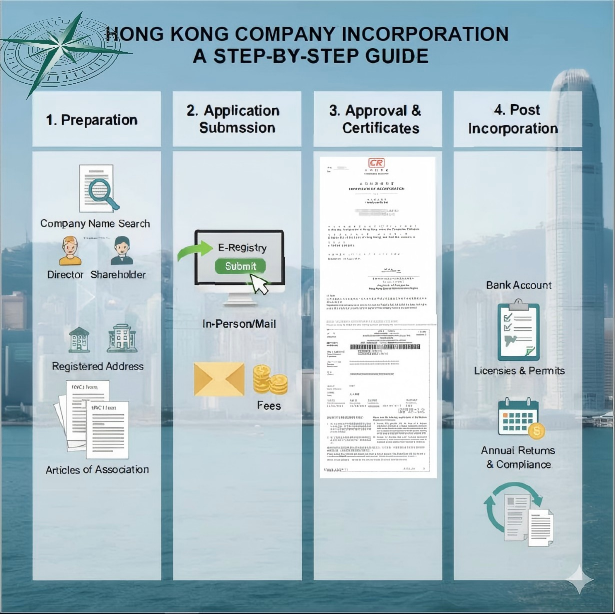
1. Pre-Incorporation Decisions & Preparation
- Choose a Company Name:
- The name must be unique and not identical or too similar to an existing company name. You can search the Companies Registry’s e-Search Services.
- The name must end with “Limited” (or “有限公司” if in Chinese).
- You can have an English name, a Chinese name, or both. You cannot use a mixed-language name (e.g., “Global Trading 有限公司”).
- Appoint Key Personnel:
- Director: Minimum of one natural person (individual). They can be of any nationality and do not need to be a Hong Kong resident.
- Shareholder: Minimum of one person or corporate entity. They can be the same person as the director and do not have a residency requirement.
- Company Secretary: Must be a Hong Kong resident or a Hong Kong-incorporated corporate entity/licensed professional. The company secretary cannot be the sole director of the company.
- Decide on Share Capital:
- The minimum share capital is HK$1.
- Secure a Registered Office Address:
- This must be a physical address in Hong Kong (not a P.O. Box). This is where official government correspondence will be sent.
2. Prepare Required Documents
You will need to prepare or gather the following documents:
- Articles of Association: This document governs the company’s internal operations (usually based on standard models).
- Incorporation Form:
- Form NNC1 (for a company limited by shares) or Form NNC1G (for a company not limited by shares).
- A simultaneous application is made for the Business Registration Certificate.
- Notice to Business Registration Office (IRBR1).
- Identification Documents & Proof of Address:
- Copies of passports/Hong Kong ID for all directors and shareholders.
- Proof of residential address for all directors and shareholders (e.g., a utility bill or bank statement, usually dated within the last three months).
3. Application Submission
Applications can be submitted electronically or in hard copy:
| Submission Method | Forms to Submit | Typical Processing Time (Approx.) |
| Online (e-Registry) | Digital version of NNC1/NNC1G and IRBR1 forms. Articles of Association. | Within 1 hour (fastest option) |
| Hard Copy (In-person/Mail) | Signed NNC1/NNC1G and IRBR1 forms. Articles of Association. | Around 4 working days |
- You must pay the combined fees for the Company Registration and the Business Registration Certificate (BRC) upon submission.
4. Post-Incorporation Steps
After the application is approved, you will receive the official documents:
- Certificate of Incorporation (CI) from the Companies Registry.
- Business Registration Certificate (BRC) from the Inland Revenue Department (IRD).
The final steps to make your company operational include:
- Open a Corporate Bank Account: This is often the most time-consuming step, varying from a few weeks to longer, depending on the bank and your company’s profile.
- Set up Statutory Records: The company secretary will establish and maintain required records, such as the Register of Directors and the Significant Controllers Register (SCR).
- Apply for Specific Licenses/Permits: If your business is in a regulated industry (e.g., finance, food & beverage), you must apply for any necessary licenses.