









Tax-deductible expenses are a strategic tool for businesses to reduce their tax burden when calculating taxable amounts. Understanding the core principles and specifics of these expenses is vital for companies to effectively lower operational costs. This article explores the tax regulations governing tax-deductible expenses and provides practical guidance on applying these principles to your company’s specific circumstances, helping you enhance your financial management capabilities.
General deduction principle
Hong Kong’s tax system operates on a’ principle-based ‘rather than’ rule-based’ approach. This means that while the tax regulations outline certain principles, they do not specify exact amounts for each deductible item.
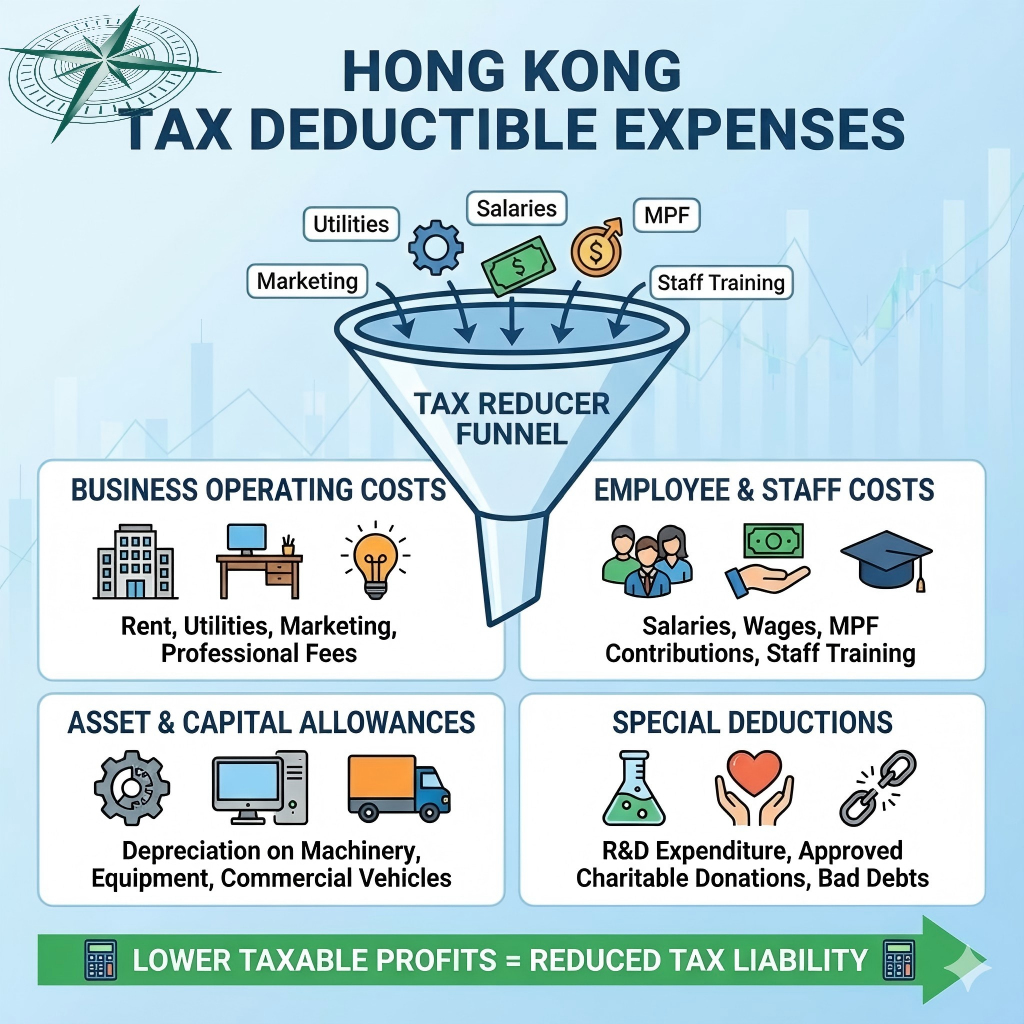
Under Section 16 of the Tax Ordinance, expenses incurred by taxpayers when generating taxable profits are generally deductible. In practice, most business expenses qualify for income deduction. Below are some common deductible items:
Common deductible item
- cost of purchase
- cost of service delivery
- Office, warehouse, and shop rental expenses
- Business-related water, electricity, and telephone charges
- Employee salaries, allowances, bonuses, benefits, severance pay, and long-term service benefits
- employer employee mandatory accumulation
- Employee welfare expenditure, including rent subsidies
- registration fee for trademark, design or patent
- customer bad debt
- all business related maintenance costs
- All business-related insurance premiums, such as: labor insurance
- social engagement expenses
Generally, all business expenses incurred for profit generation are tax-deductible. However, it’s crucial to retain supporting documentation for deductible expenses, proving they were made to generate taxable profits. Entertainment expenses are a common contentious deduction for small and medium-sized enterprises (SMEs). Often, companies keep receipts but fail to track which specific client or sales activity the expense relates to, leaving the tax authority unable to substantiate the deduction.
Non deductible expense
- household or private expenditure
- capital expenditure or loss
- non taxable expense
- Compensation, capital interest, and loan interest paid to the owner or the owner’s spouse (in sole proprietorship), or to the partner or the partner’s spouse (in partnership).
- Non-Mandatory Mandatory Provident Fund Contributions (Tax Ordinance-Excluding Section 16AA)
Special item deduction
- Expenditure on building renovation: Capital expenditure incurred for the renovation or refurbishment of commercial buildings, deductible over five years from the tax base year when the payment is actually made.
- Expenses for purchasing machinery and industrial equipment for manufacturing purposes: These expenses are deductible in their entirety during the tax base period in which they are incurred.
- Expenses for computer hardware and software: are deductible in full during the tax base period in which they are incurred.
- Purchase of environmental protection equipment: Such expenses may be fully deducted during the tax assessment period in which they are incurred.
- Purchase of environmental protection equipment: deductible for five years starting from the year the expenditure is incurred
- Purchase of eco-friendly vehicles: the full amount can be deducted in the tax assessment period when this expense is incurred.
Depreciation allowance
Common categories include office equipment, air conditioning, machinery, and vehicles, which qualify for an initial tax-deductible amount (60% of the asset cost). The annual tax-deductible amount is calculated based on the depreciating value of the asset, with rates of 10%,20%, and 30% respectively. Assets with the same annual tax-deductible depreciation rate are grouped into the same “aggregated group” for calculation.
+
Commercial building allowance
A typical example is office renovation expenses, where the annual tax exemption is 4% of the construction cost. Upon the termination of ownership, either a “surplus tax exemption” is granted or “surplus taxation” is levied.
Tax deduction on donation
Donations to accredited charitable organizations are eligible for tax deduction, provided that the total donation amount must be no less than $100 and no more than 35% of the adjusted taxable profit before tax deductions.
Conclusion
Hong Kong’s tax system is relatively straightforward compared to other countries. This article aims to help readers better understand the current tax framework in Hong Kong, including allowable and non-deductible items, as well as the appropriate deduction methods for different categories. For any questions regarding corporate tax filing or specific deduction items, please feel free to contact Yisi Accounting for further assistance.
Frequently Asked Questions
What kind of expenses qualify for tax deductions in Hong Kong?
Under the core principle of Section 16 of Hong Kong’s Tax Ordinance, any expenditure incurred to earn taxable profits that is not inherently a capital expenditure or private household expense is generally deductible. Hong Kong’s tax system operates on a “principle-based” approach, meaning the legislation does not explicitly list all deductible items but determines eligibility based on whether the expenditure is directly related to business operations. Therefore, companies must maintain all relevant documentation and detailed records—such as meeting minutes or customer information—to demonstrate that the expenditure was entirely incurred to generate business income, thereby meeting the audit requirements of the Inland Revenue Department.
Can the company’s business entertainment expenses paid to clients be tax-deductible? What are the key considerations?
Yes, hospitality expenses for client engagements are generally considered deductible, provided they are incurred to generate taxable profits. However, such expenses often become contentious during tax audits, as retaining only meal receipts is insufficient. Companies must provide comprehensive documentation detailing the event’s date, amount, venue, names and companies of participating clients or potential clients, along with the meeting’s business purpose (e.g., discussing specific contracts or projects). Without supporting evidence demonstrating business relevance, the tax authority may question and deny the deduction claim.